Article
Investment Begins to Become an Engine of Indonesia's Economic Growth, What Is the Impact on Industrial Estates?
14 Agustus 2026
14 Agustus 2026
As investment increasingly becomes a driver of Indonesia's economic growth, the need for production space, warehousing, logistics, and industrial estates is also an important part of business expansion.
Laksana Business Park, August 14, 2026
When Investment Starts to Become a Growth Engine
Indonesia's economy is entering an interesting phase in 2026.
It is not only public consumption that is the driver of the economy. Investment is starting to take an increasingly important role in building national economic capacity.
The government recorded Indonesia's economic growth in the second quarter of 2026 to reach 5.29%. In terms of contribution to growth, investment accounts for around 39%, higher than the contribution that is usually in the range of 28-29%.
In the same period, investment growth reached 6.87%, higher than the growth of household consumption of 5.06%.
This change is important for the business world because investment means an increase in production capacity and business activities.
Investment Means Needs Space
When investment enters a sector, the company's needs usually do not stop at capital.
Companies need production facilities, warehouses, offices, labor, utilities, and distribution networks.
Therefore, increasing investment can also create a need for industrial land, warehousing buildings, manufacturing facilities, and supporting infrastructure.
BKPM data shows that Indonesia's investment realization in the first semester of 2026 reached IDR 1,010.6 trillion, growing 7.2% compared to the same period the previous year. The investment also absorbs around 1.45 million workers.
Manufacturing and Logistics Still Need the Region
Based on BKPM data, sectors with large investment realization in the first semester of 2026 include the basic metal and metal goods industry, mining, transportation, warehousing and telecommunications, as well as housing, industrial estates and offices.
This means that investment growth creates interconnected needs.
Factories need warehouses. Warehouses need distribution. Distribution needs transportation access.
Ultimately, all of these activities require a supportive operational environment.
Industrial Estates Become Part of the Investment Ecosystem
Companies that expand are not only looking for land.
They also consider access, utility, security, infrastructure, legality, and ease of carrying out business activities.
Therefore, industrial estates have an increasingly important function as an ecosystem where companies build and develop their business activities.
The government itself calls the acceleration of industrial estate development as part of efforts to maintain national investment momentum.
Tangerang Remains Relevant for Industrial and Warehousing Activities
In the midst of the development of new investment centers in various regions, the Greater Jakarta area continues to play an important role in manufacturing, trade, and distribution activities.
Tangerang has proximity to Jakarta as well as access to various major transportation networks, including Soekarno-Hatta Airport.
This condition makes industrial estates in Tangerang remain one of the alternatives for companies that need a location to run or develop operational activities.
Laksana Business Park
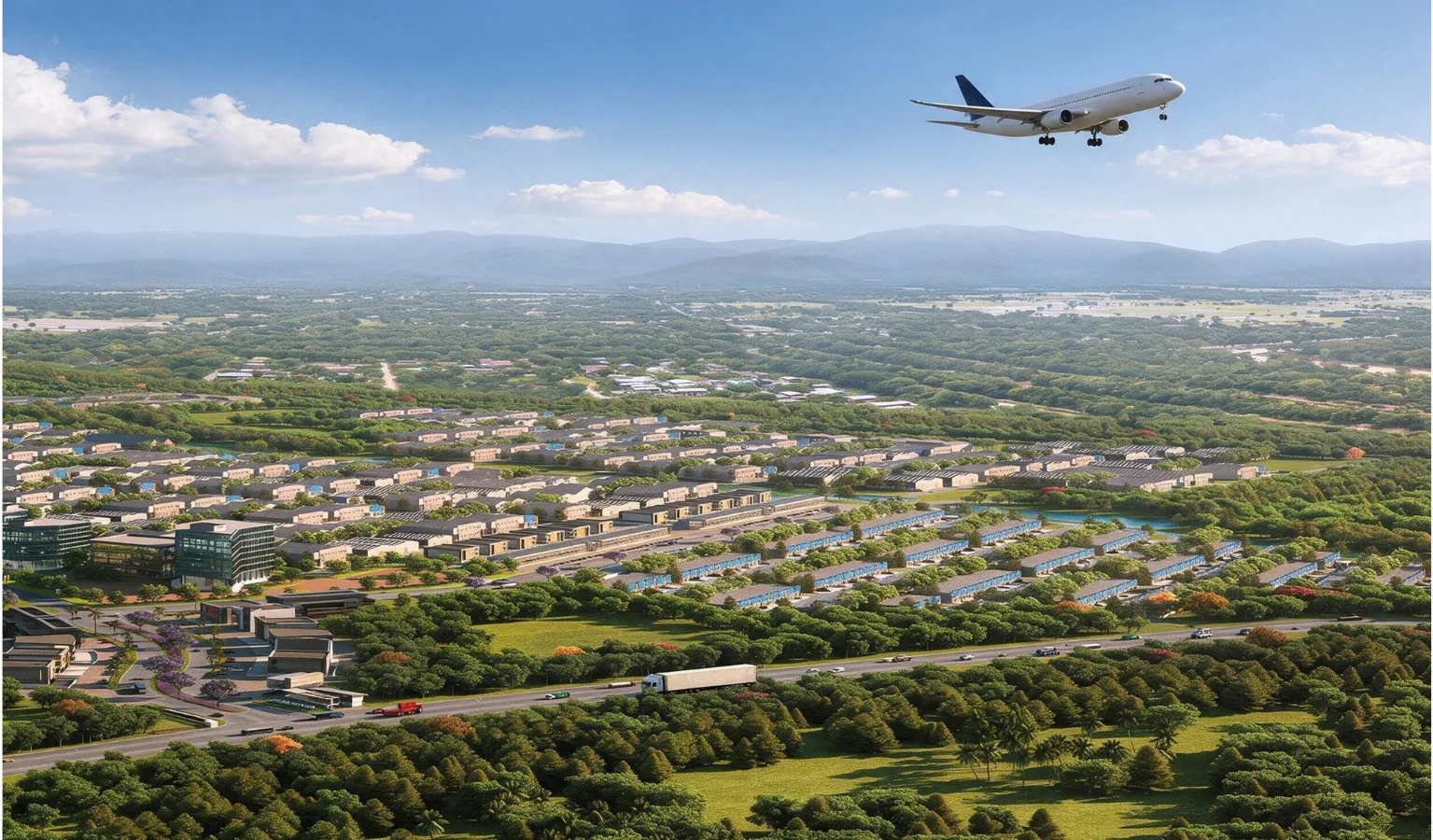
Laksana Business Park was developed as an industrial and warehousing area in Tangerang and already has an Industrial Estate Business License (IUKI).
This area is about 20 minutes from Soekarno-Hatta Airport, with travel times that can vary depending on traffic conditions.
For business needs that require several functions in one location, Laksana Business Park also presents Luxima, a 4-in-1 concept that combines warehouses, offices, residences, and business areas.
This concept is one of the alternatives for business actors who prioritize practicality in carrying out business activities.
As the Economy Grows, Companies Need New Capacity
Economic growth, which is increasingly supported by investment, provides an important message for the business world: business capacity needs to be prepared before these needs become an obstacle.
Companies that are expanding need to consider the needs of space, warehouses, distribution, and operational facilities from the beginning.
Because investment is not only about how much capital is invested, but also where the capital will be used and how the facilities support business growth.
Conclusion
Investment is increasingly playing an important role in Indonesia's economic growth.
With economic growth in the second quarter of 2026 of 5.29% and investment contributing around 39% to growth, production capacity building is an important part of national economic development.
For the industrial world, these developments mean that the need for production space, warehousing, logistics, and industrial estates will remain an important part of business expansion.
When investment begins to become an engine of economic growth, industrial estates become one of the spaces where this growth is realized into real business activities. (JP)
FAQ
What will be Indonesia's economic growth in the second quarter of 2026?Indonesia's economic growth in the second quarter of 2026 reached 5.29%.
How much does investment contribute to economic growth?Investment accounted for around 39% of economic growth in the second quarter of 2026.
What is the realization of Indonesia's investment in the first semester of 2026?Investment realization reached IDR 1,010.6 trillion or grew 7.2% on an annual basis.
Why is investment growth related to industrial estates?Investment in manufacturing, logistics, and productive sectors requires facilities such as industrial land, warehouses, infrastructure, and operational space.
Does Laksana Business Park have IUKI?Yes. Laksana Business Park already has an Industrial Estate Business License (IUKI).